Municipal services and elections: automating safely, according to Solutions Numériques
How can town halls adopt AI without weakening services before elections? Dominique Péré (HelloSpot) shares his analysis in Solutions Numériques.
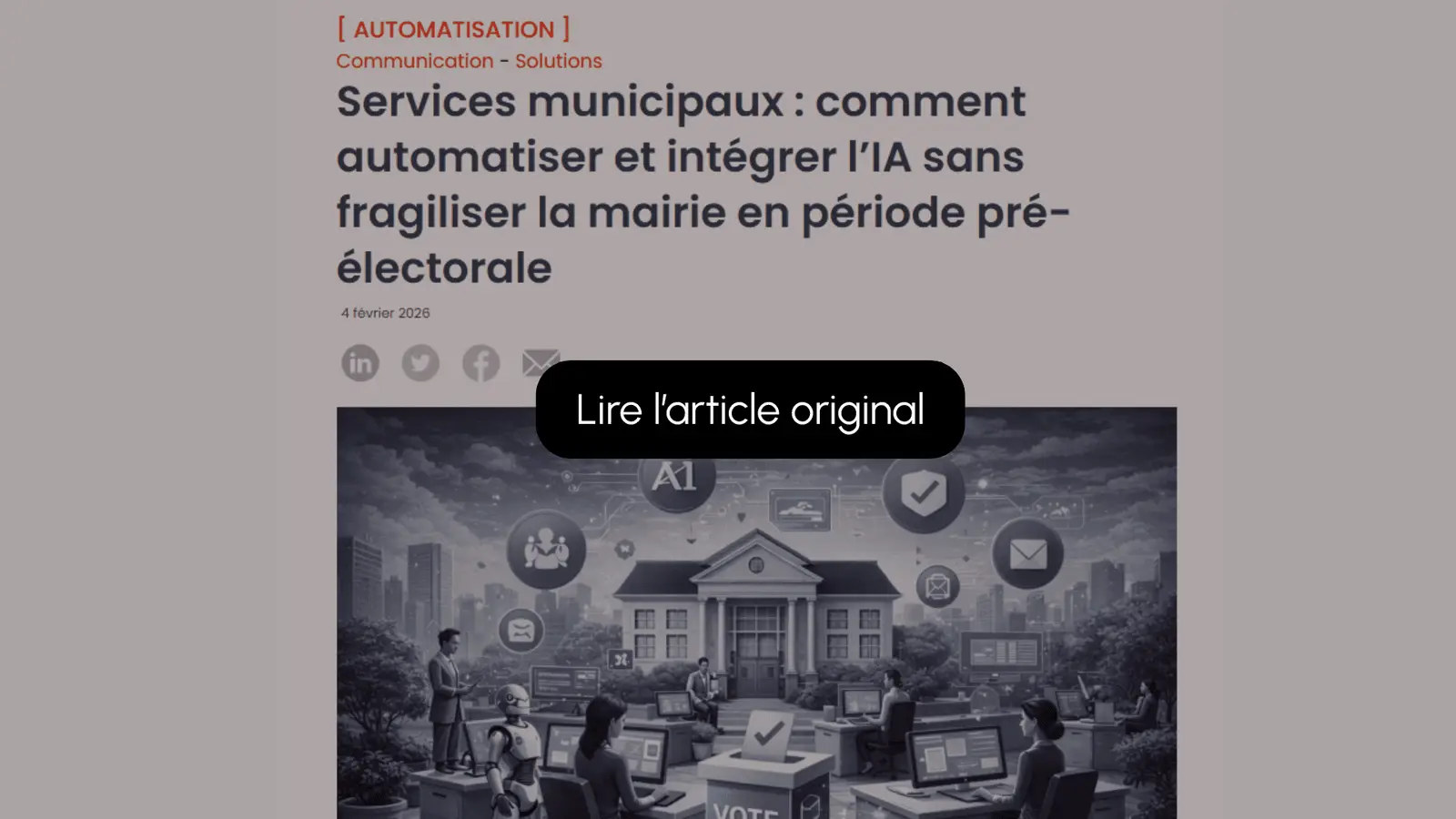
Municipal elections are approaching and, with them, growing pressure on public services. Caught between the fear of making mistakes and the need to answer ever more demanding residents, town halls are walking a tightrope.
In a recent article published by the French tech magazine Solutions Numériques, Dominique Péré, chief operating officer at HelloSpot, takes stock of the reality on the ground and shares the keys to adopting AI without destabilizing town hall services.
Here are the main lessons from the interview.
1. The situation: “an administrative process under pressure”
As the article points out, 73% of French people completed a procedure online in 2024, but nearly half ran into difficulties. The result? The phone still rings just as much (43% of requests), and staff, expected to handle everything (from planning permission to the school canteen), are wearing themselves out.
Dominique Péré recalls an often forgotten truth: “Humanly speaking, doing too many things at once often means doing none of them very well.”
In this pre-election context, where any mistake can become a political issue, the status quo is no longer an option. Service bottlenecks (as seen with passports) create friction that town halls absolutely must resolve to maintain trust.
2. The danger of “shadow IT”: when AI moves in without a framework
This is the warning Dominique Péré sounds in the Solutions Numériques article: AI is already here, but often in an uncontrolled way.
To save time, “more than half of staff already use consumer AI tools” to summarize letters or draft replies. While the intention is commendable, the risks are huge:
- Data leaks: residents’ information passes through unsecured servers.
- Factual errors: as Dominique Péré illustrates with the example of electoral registration dates, a generic AI can make up wrong answers (hallucinations), putting the town hall’s liability on the line.
3. The HelloSpot solution: automating to stay in control
The article highlights HelloSpot’s pragmatic approach: automation is not there to replace staff, but to structure requests.
Unlike consumer tools, a dedicated business solution like HelloSpot makes it possible to:
- Secure the data: strict GDPR compliance and sovereignty, unlike shadow IT.
- Qualify the request: the AI does the groundwork of understanding it. Staff no longer waste time on data entry; they make decisions.
- Integrate local complexity: an AI fed with the municipality’s specific rules (local urban plan, or PLU, and local regulations) becomes a reliable assistant in the face of layer upon layer of standards.
“For a human, it’s complex. For a properly fed AI, it’s perfectly manageable,” says Dominique Péré.
Good news for small municipalities
The Solutions Numériques article also reveals a major announcement: the upcoming launch of a free core version of the HelloSpot platform.
This initiative aims to let small town halls, often held back by their budgets, take a first step toward automation with no upfront investment. A concrete way to maintain quality public services everywhere in the country.